AI Data Centres
In a recent article, we explored the data centre industry’s shift toward prefabricated and modular infrastructure in response to unprecedented demand for capacity on compressed timelines. Demand for artificial intelligence is surging, with the global AI market projected to grow from $189 billion in 2023 to $4.8 trillion by 2033. The rise of AI-optimised data centres, alongside rapid advances in chip technology, is driving the need to both build new, purpose-built facilities and retrofit existing ones.
At the same time, chip development cycles are accelerating. In 2024, NVIDIA announced a move from roughly two-year GPU release cycles to an annual cadence. This creates a new challenge: with each generation potentially introducing different power, cooling, and density requirements, data centres risk becoming outdated more quickly. As a result, customers are demanding capacity by 2028 rather than 2030 to avoid facilities becoming misaligned with the latest chip architectures.
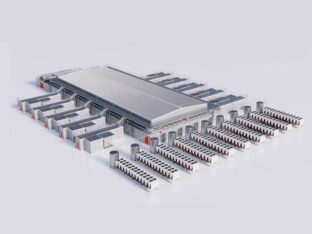
A solution to this challenge is modular, prefabricated data centres, which enable capacity to be deployed, upgraded, and scaled with far greater flexibility than traditional builds. Modular designs allow operators to retrofit or replace individual components, such as power or cooling modules, as new chip generations introduce different requirements, avoiding costly full-site overhauls. While entire facilities can be modular, this article focuses specifically on one critical component: the modular uninterruptible power supply (UPS).
If you are not sure what a UPS is, we highly recommend you check out our last article, UPS: The hidden systems keeping data centres online. But as a quick refresher, a UPS is the first line of defence when something goes wrong with the power supply. When the grid experiences an outage, voltage dip, or sudden surge, UPS systems instantly step in to protect the IT load, ensuring servers, storage systems, and network equipment continue operating without interruption. Crucially, they can only maintain power for a short amount of time, bridging the gap between the power outage and when backup generators come online.
Traditionally, data centres relied on monolithic UPS units. This is similar to buying an oversized boiler for a small home. You pay for capacity you do not need and operate inefficiently. Today, the most transformative change in the industry is the shift to modular systems, where multiple smaller power modules operate together within a single frame to match actual demand. This brings a range of benefits, most notably the ability for data centres to “pay as they grow,” scaling power capacity in line with demand simply by adding additional modules.
For example, a 1 MW IT load could be supported using twelve 100 kW modular UPS units. In an N+2 redundancy configuration, ten modules would be sufficient to meet the 1 MW demand, while the additional two modules provide redundancy. This means that if up to two modules are offline for maintenance or fail, the remaining modules can still support the full IT load without interruption. This modular approach enables capacity to be deployed incrementally, reducing upfront capital expenditure compared to a single large fixed system. It also improves operational efficiency by allowing modules to operate closer to their optimal load levels, while maintenance can be carried out on individual units without affecting overall system availability.
Another benefit is the ability to pinpoint errors when issues arise. Think back to physics lessons at school. Modularity adds redundancy. When a single light bulb fails in a series circuit, they all go out. In contrast, in a parallel system, one faulty bulb does not bring down the whole system. The same applies to modular UPS. Instead of the entire system going down, if a single module fails, the rest will continue to operate, improving fault tolerance. Individual modules can be replaced or serviced without taking the entire system offline, which improves operational resilience and uptime.
When it comes to battery systems, advances in battery technology are driving a shift toward lithium-ion UPS solutions rather than traditional lead acid. Lithium-ion batteries have a longer life of around 10 to 15 years, compared to lead acid batteries, which typically require replacement every 3 to 5 years. Although lithium-ion systems have a higher upfront cost, this is balanced over time by reduced replacement frequency and their ability to handle more charge and discharge cycles. Lithium-ion batteries can also recharge to about 80% capacity within 2 to 3 hours, which is significantly faster than lead acid alternatives. Lithium-ion systems are also around 30% more compact, helping reduce overall footprint compared to traditional monolithic systems.
Modularity is reshaping how UPS systems are deployed and managed in modern data centres. By moving away from monolithic architectures toward modular, scalable systems, operators gain the ability to add, replace, and maintain capacity incrementally, aligning power infrastructure more closely with evolving IT demand.