
Industry
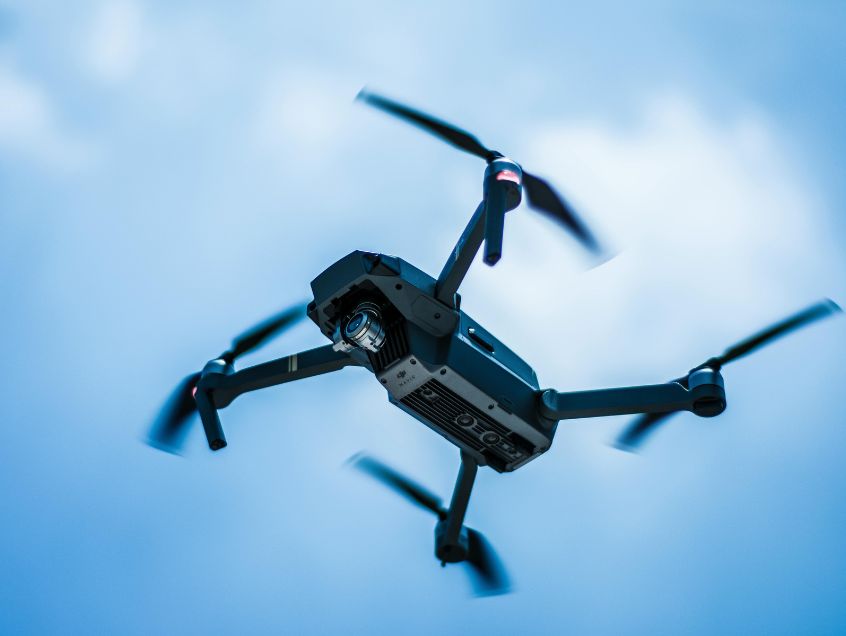
Drones are used to film your favourite nature shows, fight in combat, and now even take your next day delivery expectations down to the hour. Unmanned aerial vehicles, or UAVs, are increasingly used across industries from filmmaking to retail. But their usefulness relies on one critical thing. Batteries. In a constant battle between how far drones can travel and how much they can carry, innovation in energy storage could be the key to unlocking the next generation of drone technology and lifting every industry they touch along with it.
Drones are already changing human behaviour. If you’re halfway through a DIY job and forget something essential, instead of popping to the shops, you can now rely on Amazon. Prime Air uses drones to deliver packages weighing up to 2.2 kilograms in under 60 minutes. With multiple sites across the US and the first UK site set for Darlington, they are taking convenience to a whole new level.
The battlefield has changed too. What was once fought with guns and foot soldiers now looks more like a game of drones. Over in Ukraine, UAVs have completely reshaped the combat landscape. From kamikaze drones with ranges of over 40 kilometres capable of crashing into targets and exploding, to surveillance units guiding operations from the sky. Ukraine has seriously accelerated its drone production in recent years. In 2024, more than two million UAVs were built. In 2025, that figure is expected to exceed four and a half million. The scale alone shows just how central drones have become to modern warfare.
But when it comes to drones, there is a serious trade off. Operators want to maximise range and also maximise payload capacity, which is the weight a drone can carry and still fly safely. The challenge is that improving one often limits the other.
Delivery drones used in rescue efforts, or to bring you the next book in a gripping trilogy, need to carry weight because that is their core function. Yet, even without a payload, specialist drones carry onboard sensors, cameras, navigation systems, and communications equipment, which all add weight. On top of that, they must store enough energy to travel long distances and handle sharp power spikes during take off and complex manoeuvres.
This trade off isn’t just a technical frustration. It becomes critical in real missions. When deploying a wildfire drone, you don’t want to compromise between the drone being able to stay in the air long enough to track the fire’s movement or carrying the thermal camera that actually shows where the fire is headed. Endurance without the right tools is half a mission. Improving battery technology is what reduces this tension, allowing drones to go further without sacrificing what they can carry.
And there’s serious money behind solving this problem. The UAV battery market is projected to reach $2.41 billion by 2030, driven by demand across construction, agriculture, logistics, and defence.
The type of battery a drone needs depends entirely on what it is being used for. Lithium ion batteries are widely used because they can last for thousands of charging cycles. This makes them a popular choice for UAVs that need endurance, particularly in logistics and longer range operations. Lithium polymer batteries, often known as LiPo, are used more for agile, high power tasks such as drone racing and filming. They can discharge much more rapidly and offer higher energy density, which is useful when performance matters most.
However, both lithium battery types struggle at temperature extremes. In sub zero conditions, batteries can become cold enough that the chemical reaction slows down, cutting capacity by up to 50%. In hot conditions, the risk flips in the other direction. Overheating can lead to short circuits and thermal runaway, which is exactly what causes lithium battery fires in e-scooters and power banks.
This has led to growing interest in alternatives such as solid state batteries. Solid state systems are often described as the holy grail. They are safer than lithium ion batteries, more energy dense, and far more stable. If commercialised at scale, they stand to transform not only UAVs, but also electric vehicles and energy storage more broadly. For drones specifically, that could mean longer flight times, faster charging, and significantly reduced fire risk.
Aside from batteries, fuel cell technology is also pushing endurance further. You may have seen vehicles powered by hydrogen, where the only byproduct is water. That same technology is now appearing in drones. Companies like Intelligent Energy are producing UAV systems that can fly up to three times further on a single tank of hydrogen compared to an equivalent battery powered platform. That kind of range changes what is possible for long distance missions, persistent surveillance, and critical response operations. It also shifts how operators think about downtime, refuelling, and mission planning. Instead of returning to charge, drones can stay airborne for hours at a time.
Drones now sit at the centre of how goods move, how wars are fought, and how emergencies are managed. Yet for all the advances in software, autonomy, and sensors, their future still comes back to something far more fundamental. Power.
The tradeoff between range and payload defines almost every drone mission today. It limits what drones can carry, how far they can go, and how long they can stay there. Whether it comes from safer lithium systems, solid state breakthroughs, or hydrogen fuel cells, if this compromise can be properly broken, the impact will ripple across every sector already relying on UAVs.