Robotics & Physical AI
Back in 1778, something revolutionary happened. James Watt and Matthew Boulton refined the steam engine so it could power factory machinery at scale. With hindsight, it feels almost obvious: burn coal, boil water, use steam to drive motion. But what feels straightforward to us now was groundbreaking then. In an eighteenth-century factory, steam might have powered textile looms, driven metal presses or hammers, and operated water pumps or hoists, replacing slow manual work. It helped define the Industrial Revolution and reset expectations of what industry could achieve.
Jump forward nearly two centuries and the factory floor shifted again. In 1961, the Unimate 1900 became the first mass produced robotic arm for factory automation. General Motors put it to work and saw output climb to 110 cars per hour, more than double their competitor output at the time. Fixed in place but tireless, it marked the moment automation began to scale in a serious way. That early breakthrough paved the way for the expansion we see today. Over four million robots are now working in factories worldwide, most concentrated in Asia, followed by Europe and the Americas, with companies like Amazon leading the charge. In 2025, Amazon marked a major milestone by deploying its one millionth robot across its operations.
And now we are at another inflection point. Advances in battery technology are changing what automation looks like inside warehouses. No longer confined to static arms bolted to the floor, systems can move, adapt and operate where they are needed. It’s not just another upgrade in machinery. It is a shift in how energy is delivered and how work gets done.
Ask most people where batteries are having the biggest impact, and they’ll probably point to the electrification of transport. EVs and charging stations are hard to miss; you see them every time you step outside. On the other hand, most people have never set foot in a warehouse, even though behind the scenes the same battery technology is transforming how these spaces operate.
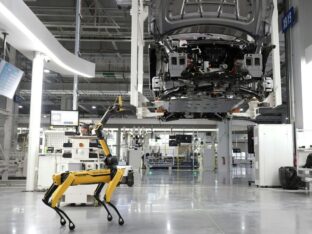
Unlike the fixed robotic arms of the past, which were bolted in place and limited to repeating a single task, today’s warehouses have a new breed of worker. Thanks to batteries and advances in technology, autonomous mobile robots can move freely across the floor, carry heavy loads, navigate complex layouts, and adapt to changing conditions in real time. Cameras and computer vision let them spot specific items and avoid obstacles, and artificial intelligence allows them to make decisions on the move, coordinating seamlessly with other machines across the floor. They even tell you when they need attention through predictive maintenance which helps avoid unexpected breakdowns, and in the not so distant future humanoid designs will let warehouse robots reach, grip, and perform a variety of tasks, handling work that single-purpose machines simply couldn’t.
Breaking free from the limits of fixed power sources marks the next revolution, and it didn’t happen overnight. Innovations in battery technology are what make these robots practical. Modern batteries are not just more powerful, they are smarter and more efficient. High-density designs pack extra energy into a lighter package, allowing robots to move faster, carry heavier loads, and work longer without stopping. Fast-charging technology allows them to recharge in minutes rather than hours, keeping operations fluid and reducing the number of units required. Removable, swappable batteries further cut downtime, allowing robots to keep moving without waiting for human intervention. It’s big business too. In 2025, the industrial robot battery market was valued at $2.58 billion and is expected to reach $4.67 billion by 2030. This growth is being driven by the increasing demand for faster, more flexible warehouse operations, and the rise of new companies developing next-generation battery solutions.
One standout company in this space is Nyobolt, founded in 2019, which develops high-power, ultra-fast charging batteries for industrial robots. Its technology provides more energy in a lighter package and longer life cycles than traditional lithium-ion solutions. These batteries are being used in Symbotic’s SymBot™ autonomous mobile robots, allowing them to travel further between charges, operate longer, and maintain consistent performance over time. With faster charging, improved reliability, and extended cycle life, Nyobolt’s innovations illustrate how advances in energy storage are making warehouse automation more flexible, efficient, and resilient for the demands of modern supply chains.
Energy has always defined the possibilities of industry, from steam to electricity, from fixed robotic arms to fully autonomous mobile systems. Today’s battery-driven warehouse robots are not just faster or stronger, they are smarter, more adaptable, and capable of operating in ways that were previously impossible. By combining high-density energy storage with AI, computer vision and predictive maintenance, warehouses can now run 24/7, optimise workflows in real time, and unlock productivity levels that once seemed out of reach. This is not a marginal upgrade. It is the next revolution in industrial automation, one that finally matches the promise of mobility with the power to keep moving.