Robotics & Physical AI

Warehouses have been the backbone of goods distribution for centuries. They’re not glamorous, and for most people they remain invisible, but they have been absolutely crucial to human progress and will remain vital to its future. Most people will go through their entire lives without ever seeing the inside of a warehouse. Fewer still will realise that the most critical factor in warehouse logistics is not the size of the building or the shape of the goods being handled, but how energy is applied to make the system work.
Each era of logistics reflects the dominant and cheapest form of available power. Human muscle, intuitive but limited, defined the earliest warehouses. Fossil-fuelled machinery brought brute strength and scale, but at the cost of flexibility. Mains-powered automation delivered speed and efficiency, but remained fixed in place. Today’s shift is already underway, and it is not simply about automation in the form of static robotic arms. It is an energy transformation.
Before and during the Industrial Revolution, beginning around 1760 in Britain, warehousing was rudimentary by modern standards. Goods were lifted, carried, stacked, and sorted almost entirely by hand, sometimes including the manual shovelling of bulk commodities such as grain in low-ceilinged buildings with narrow aisles. Operations were slow, physically demanding, and often dangerous. The advantages were simplicity and flexibility: capital requirements were low, entry barriers were minimal, and warehouses could adapt quickly to changes in goods or demand by adding labour. However, productivity was tightly constrained by human endurance. Injury rates were high, labour availability was volatile, and output could not be sustained at scale.
The post-Second World War period marked a decisive shift. As governments downsized wartime logistics operations, large amounts of warehouse space, equipment, and expertise entered the civilian economy. Forklifts, standardised pallets, conveyor systems, and high-bay storage became widespread, powered by fossil fuels and mains electricity. Throughput increased dramatically, and goods could be moved faster and more reliably than ever before. Yet these gains came at a cost. Mechanical systems were capital-intensive, embedded into fixed layouts, and difficult to adapt when demand shifted. Speed and scale improved, but flexibility and resilience declined, leaving humans responsible for exceptions, judgement, and recovery.
As overused as the term may be, “revolution” is an accurate description of what is currently happening in warehousing. While the core goals of storage, movement, and distribution remain unchanged, the way power is delivered has shifted entirely. This shift has been driven by the convergence of advances in battery technology, autonomous robotics, and intelligent software.
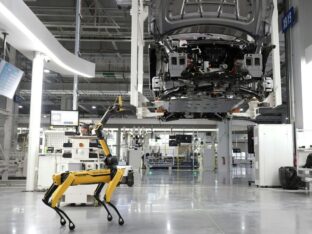
Battery innovation, widely discussed in the context of electric vehicles and grid storage, has been particularly transformative for warehouses. Mobile robots have been effectively unbolted from the floor, equipped with sensors, onboard computing, and high-power-density lithium-ion batteries, and tasked with work traditionally performed by humans or fixed machinery. Crucially, these systems can operate almost continuously. Studies of warehouse robotics deployments show that by implementing high-density batteries, companies can reduce their robot fleet size by up to 40% whilst maintaining the same operational capacity.
Fast charging and opportunity charging reduce the need for shift-based battery changes and dedicated charging rooms, while also freeing up valuable floor space. Operators report measurable productivity improvements, with some facilities robot uptime tripling as a result of implementing these strategies. These gains are not driven by raw speed alone, but by consistency. Robots do not tire, degrade in performance over a shift, or require downtime for battery swaps when energy is managed correctly.
Critics point out that charging infrastructure can be expensive to retrofit, and that lithium-ion systems introduce new safety considerations, including thermal runaway risk. These concerns are real and well documented in workplace safety guidance. However, they are largely financial, regulatory, and procedural challenges rather than fundamental technical barriers. Improved chemistries, battery management systems, fire-suppression design, and zoning strategies have significantly reduced operational risk in modern deployments.
Longer-lasting and faster-charging batteries enable more than mobility. They support sophisticated sensor suites, continuous connectivity, and real-time optimisation software that fundamentally changes warehouse safety and efficiency. Unlike forklifts driven by humans or conveyor systems with limited sensing, autonomous robots operate with persistent 360-degree awareness and dynamic routing.
The impact on safety has been significant but double-edged. Warehouses adopting autonomous systems report reductions in serious workplace injuries, however there is a marked increase in minor injuries, especially around busy periods. Also, workers in autonomous warehouses, despite feeling less physically exhausted than legacy warehouses, face issues of repetitive strain with specific rather than varied tasks. Overall, fewer people operating in high-traffic logistics zones reduces both actual risk and perceived risk, which in turn improves retention in an industry traditionally challenged by labour churn.
The trade-off is dependency. Procuring and operationalising battery-powered robotics can require substantial upfront investment, sometimes running into the tens of millions of dollars for large facilities once robots, batteries, charging infrastructure, software integration, and long-term support are included. Warehouses increasingly become purpose-designed around robotic workflows, making rapid reversion to manual operations difficult. Disruptions to battery supply chains or mains power availability can therefore have outsized impacts. However, this dependency is not new. Mechanical warehouses were equally reliant on fuel, spare parts, and grid power. The difference today is that energy has become a first-order design constraint rather than a background assumption.
Just as pre-industrial warehouses were designed around human capability, and mechanical warehouses around fixed machinery, modern warehouses are increasingly designed around energy flow and power management. Batteries are no longer peripheral components. They are both the primary operational bottleneck and the greatest enabler of modern logistics.
Viewed through history, warehousing is a sequence of energy-constrained evolutions. Human-powered systems were flexible but biologically limited. Mechanical systems delivered scale and speed but embedded rigidity. Battery-powered robotics represent a genuine shift because their limits are energy-based, and those limits are rising steadily with improvements in battery chemistry, charging strategies, and software control.
As a result, warehouses are beginning to resemble microgrids. On-site battery storage, peak-shaving strategies, load balancing, and intelligent charging are becoming integral to operational performance rather than peripheral energy considerations. Productivity is increasingly tied not just to how goods move, but to how power is generated, stored, and deployed.
Warehousing was once about moving goods. Increasingly, it is about managing energy. The next logistics transformation will not be driven by faster hands or larger machines, but by better batteries and the systems that manage them.