
Electric Vehicles
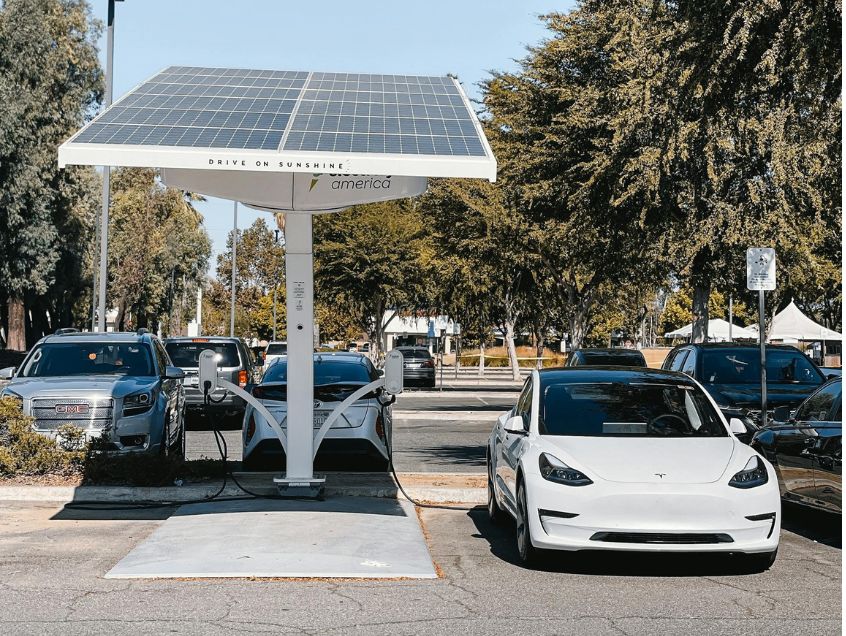
Decarbonising transport is one of the toughest challenges we face. It touches daily life, from commuting and moving goods to connecting cities and enabling global trade. Today, transport produces more than a third of the world’s CO2 emissions, with global demand for passenger transport expected to nearly triple by 2050. In the EU, road traffic alone accounts for about a fifth of emissions, with passenger cars contributing the lion’s share. To stay on track for net zero by 2050, CO2 emissions from transport need to start falling quickly, by more than 3% each year through 2030. Electric vehicles are expected to play a major role in achieving this. Adoption is accelerating rapidly: by the end of 2024, nearly 58 million electric cars were on the road, making up around 4% of all passenger vehicles and more than three times the total recorded electric car fleet in 2021. Yet, despite this momentum, transport emissions are still rising. The reason is simple. Adoption is not happening fast enough, or at the scale required. Technology has moved ahead of behaviour, and one barrier continues to loom larger than most. Charging.
Ask someone why they have not switched to an electric vehicle and you are likely to hear the same concerns repeated. Charging takes too long. Public chargers are unreliable. Battery performance degrades over time. Long journeys feel risky.
These concerns are not irrational. For many drivers, especially those without off street parking, charging infrastructure shapes daily routines in ways petrol never did. A refuelling stop that once took five minutes can now take half an hour or more. Over time, that friction adds up. In other words, electrification cannot succeed if it feels like a downgrade.
Early electric vehicles focused heavily on range. Bigger batteries, longer distances, fewer stops. Those were the priorities at a time when charging infrastructure was scarce. But, times have changed. Fast chargers are now widespread, with over 86,000 chargepoints now available on Britain’s roads, including more than 17,000 rapid and ultra‑rapid points that can charge a car to 80% in just 20 to 40 minutes. Newer companies like char.gy, Evyve, Smart Charge, and Hubber are rapidly expanding the network to keep up with growing demand. Over the last year, the overall network grew by 23%, with a new charger installed every 33 minutes.
As charging infrastructure becomes more widespread, the focus is shifting from how far a car can travel to how quickly it can recharge. What increasingly matters is the speed at which meaningful range can be added, because that changes the psychology of driving an electric vehicle. When a vehicle can gain substantial range in just a few minutes, charging starts to feel far closer to a traditional refuelling stop rather than an extended wait.
Speed, however, comes with trade offs. Traditional battery chemistries struggle under repeated high power charging. Faster charging often accelerates degradation, shortening battery lifespan and increasing replacement rates.
That creates a new emissions problem. Manufacturing batteries is energy-intensive and material-heavy. Greenhouse gas emissions from lithium carbonate, a key mineral for EV battery production, can reach up to 18 tonnes of carbon dioxide equivalent per tonne. To put this into perspective, that is roughly equivalent to the emissions from driving an average petrol car about 80,000 miles or the annual energy use of a typical UK household for over three years. If batteries need to be replaced more frequently, the carbon savings of electrification are reduced.
Governments are beginning to recognise that batteries are strategic infrastructure. In 2024, the European Commission committed nearly €3 billion through its Innovation Fund, with the aim to encourage investment, stimulate demand, and strengthen the competitiveness and resilience of the European battery manufacturing sector by lowering risk. On the research front, significant progress has been made in ultra-fast charging, with recent demonstrations achieving 10% to 80% charge in under five minutes without compromising long-term battery capacity, twice the speed of the fastest-charging vehicles currently on the road.
At the same time, supply chain assessments suggest material availability is less of a bottleneck than once feared, provided recycling and circular economy practices scale alongside demand.
The future of transport will not be decided by abstract targets or glossy roadmaps. It will be decided in everyday moments. Pulling off a motorway. Charging during a coffee break. Running a delivery route without range anxiety. If electric vehicles can match the convenience people are used to, without sacrificing longevity or sustainability, adoption accelerates naturally. If they cannot, progress slows.
Achieving net zero transport is not just about new technology. It’s about removing friction from daily life and creating meaningful behavioural changes. And sometimes, the difference between success and stagnation comes down to how long you are willing to wait. Five minutes, give or take, might be enough to tip the balance.